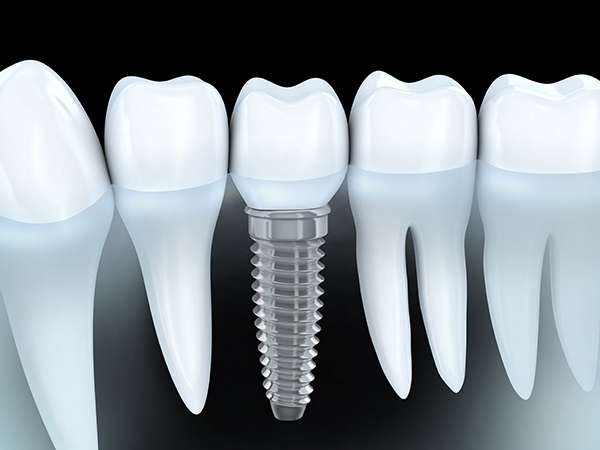
Most people know dental implants are tiny prosthetics that are used to create a new fake tooth. Few people, outside of patients who have received one, are aware of just how great a dental implant can be. For starters, dental implants are based on a simple grounding philosophy. Since the root of the tooth is the grounding for the tooth, the dental implants we use provide the same level of strength and security to the new dental crown that we place over them. Additionally, the root has a very important and symbiotic relationship with your jawbone, which works to help in stabilizing the tooth itself. Our tiny titanium implants mimic this relationship perfectly. What this does for you is it creates a circumstance where your new fake tooth is strongly grounded in an implant that is literally a perfect non-biological imitation of your root. As such you can eat anything that you would normally eat, without fear of causing unnecessary damage to your new implant or crown. This also means that you do not have to engage in special cleaning activities. Simply brush your teeth, and floss, like you would normally do and the new tooth will also get clean.
Did you know that dental implants come in two different types? Most people, even those who have dental implants, are usually not aware of this fact. There are two types of dental implants because in order for a traditional dental implant to be successful there is a prerequisite for the jawbone to be healthy. The jawbone and the dental implant have a symbiotic relationship, which means the jawbone has to have sufficient density, or bone mass, to sustain and support the implant. We will typically find this out during our initial consultations and examinations, where we will take x-rays. If your jawbone can sustain an implant, we will use the traditional implant. Also known as an Endosteal implant, this implant is a cylindrical shaped device, often a screw, made of titanium. It is inserted directly into the jawbone for maximum stability and to ensure the relationship between the two.
For other patients, however, they may not have the jaw bone density that is required to place an Endosteal implant. In cases like this the patient, you, have one of the two choices. You can have reconstructive surgery on the jaw to make it stronger and able to withstand and support the implant. The other option, for those that do not want to or cannot undergo reconstructive surgery, is to use an implant known as a Subperiosteal implant. A Subperiosteal implant functions much the same way as an Endosteal implant, with one notable exception. A Subperiosteal implant is placed into the gum but not into the jawbone. It is placed on top of, or slightly above the jawbone itself. This provides the security and stability that the dental crown needs, without putting added pressure on the already weakened jawbone. The initial examination will tell us what kind of implant you need, and we can make sure you have all the information you need to make a decision.
A dental implant procedure is a structured, multi-stage process that replaces missing teeth with a stable, long-lasting solution. If you are exploring tooth replacement options, you may be curious about what this process is like from start to finish. Having a thorough understanding of each phase helps set realistic expectations and reduce uncertainty about the…
Dental implants are an effective and modern way to go about replacing missing teeth. If you are missing a tooth, you are not alone in your predicament; most people lose one or more of their permanent teeth over the course of their lives. People lose teeth due to trauma to the face, aging, or oral…
The surgical procedure to place dental implants is similar to all others in that you need some time to recover from the operation. Implants require incisions, so the soft tissues will need to heal to seal up the wounds. In addition, the hard tissues of the jaw bone will also heal slowly, fusing the metal…
Studies show that dental implants remain the gold standard in dental restorations. These dental replacements are the most stable ones that you can get. It may be invasive, but once it heals well, you will have good dental function again. Here are the details about the process of getting dental implants.The dentist will examine the…
You can visit a cosmetic dentist and a general dentist for your cosmetic dental treatments. Both dental care providers can transform your smile. They can also enhance your oral health. Knowing the difference between a cosmetic dentist and a general dentist can help you determine where you must go to get your dream smile.This dental…
A TMJ dentist can help patients understand jaw pain, clicking, stiffness, and other symptoms linked to the temporomandibular joints. These joints connect the lower jaw to the skull and support chewing, speaking, and yawning. When the joints, muscles, teeth, or jaws do not work together well, patients may develop discomfort that affects eating, speaking, and…
 Most people know